Meldwork is a local-first work cell for AI coding agents — it orchestrates the agent CLIs you already run around one frozen task snapshot, records every finding as evidence, and puts a human adoption gate before any workspace change.
LOCAL-FIRST · MULTI-AGENT WORK CELL
Meldwork builds the organization layer for AI agents — a local work cell that keeps participants explicit, context scoped, run state inspectable, and human review in the loop.
DETECTED ON YOUR MACHINE
Meldwork detects an installed command when its adapter and the CLI version are compatible. Approved Agent Connectors can be added through the Agent Connector SDK.
THE SHORT ANSWER
Meldwork is a local-first work cell for AI coding agents — it orchestrates the agent CLIs you already run around one frozen task snapshot, records every finding as evidence, and puts a human adoption gate before any workspace change.
Codex, Claude Code, Gemini CLI, Qwen Code, Kimi Code, MiMo Code, OpenCode, OpenCodeReview, Hermes, Pi Agent, OpenClaw, WorkBuddy — detected natively on your machine.
Direct · Concurrent Responses · Auto Discussion V4
Attached to every result — dissent stays visible, never hidden behind a manager.
macOS · Apple silicon · Electron
100% local-first work cell
THE WORK CELL
Choose the local Agents and participants. Participants are always selected by you — never auto-assigned from a roster.
Bound the goal, working directory, context, and permissions. Every run starts from a frozen task snapshot.
Direct, Concurrent Responses, or Auto Discussion V4 — from a single focused session to negotiated multi-round work.
Inspect findings, evidence, and any Human Gate before the workspace changes. Nothing writes itself.
COLLABORATION MODES
Same Case, same evidence trail — different depth of agreement. Pick the mode that matches how much review the decision deserves.
One selected Agent keeps its conversation and native session when supported.
Best for focused work with one Agent.Selected Agents receive the same frozen task snapshot and return independent replies in stable order.
Best for comparing approaches before choosing one.Agents propose, challenge, negotiate responsibilities, execute dependency-aware work, then verify the result.
Best for multi-round work with explicit responsibility.WHAT YOU CONTROL
These four invariants are what make multi-agent output reviewable instead of just decorative.
Workspace writes are opt-in. Nothing changes until you adopt the result — agents don't.
Opt-in workflow controlsEvery run starts from a snapshot. All selected Agents see the same brief, in stable order.
Case-scoped, reproducibleFinding → Evidence → Decision → Disposition, attached to each result. Dissent stays visible.
No hidden managerElectron work cell on your machine. No remote Agent fleet. Conversations stay local.
Your CLI, your dataINSIDE A REAL RUN
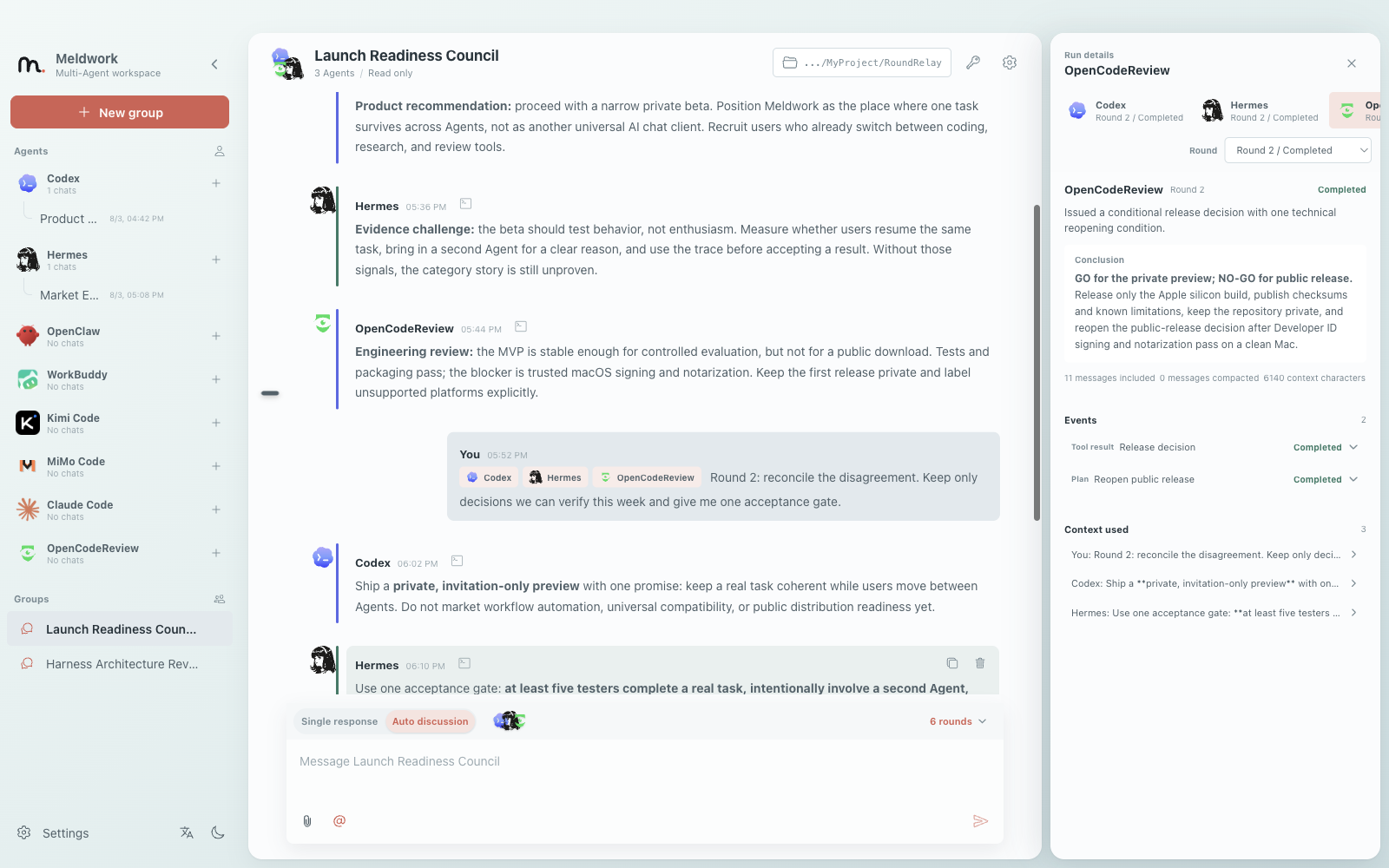
Below: the actual evidence from a V1.0.3 session where Codex, Hermes, and OpenCodeReview reviewed a private-beta release decision. Scroll or wait — the timeline advances on its own.
Ship a private, invitation-only preview with one promise: keep a real task coherent while users move between Agents. Don't market workflow automation, universal compatibility, or public distribution readiness yet.
The beta should test behavior, not enthusiasm. Measure whether users resume the same task, bring in a second Agent for a clear reason, and use the trace before accepting a result. Without those signals, the category story is still unproven.
The MVP is stable enough for a controlled evaluation, but not for a public download. Tests and packaging pass; the blocker is trusted macOS signing and notarization. Keep the first release private and label unsupported platforms explicitly.
Round 2: reconcile the disagreement. Keep only decisions we can verify this week and give me one acceptance gate.
Ship V1.0.3 to the private preview only. No-Go for public release. Reopen after Developer ID signing and notarization pass on a clean Mac.
INSIDE THE WORK CELL
Pick the participants before any work runs. Meldwork detects installed CLIs and shows their adapter status.
Findings, evidence, and adoption decisions live in one Case. Dissent stays visible — never hidden behind a manager.
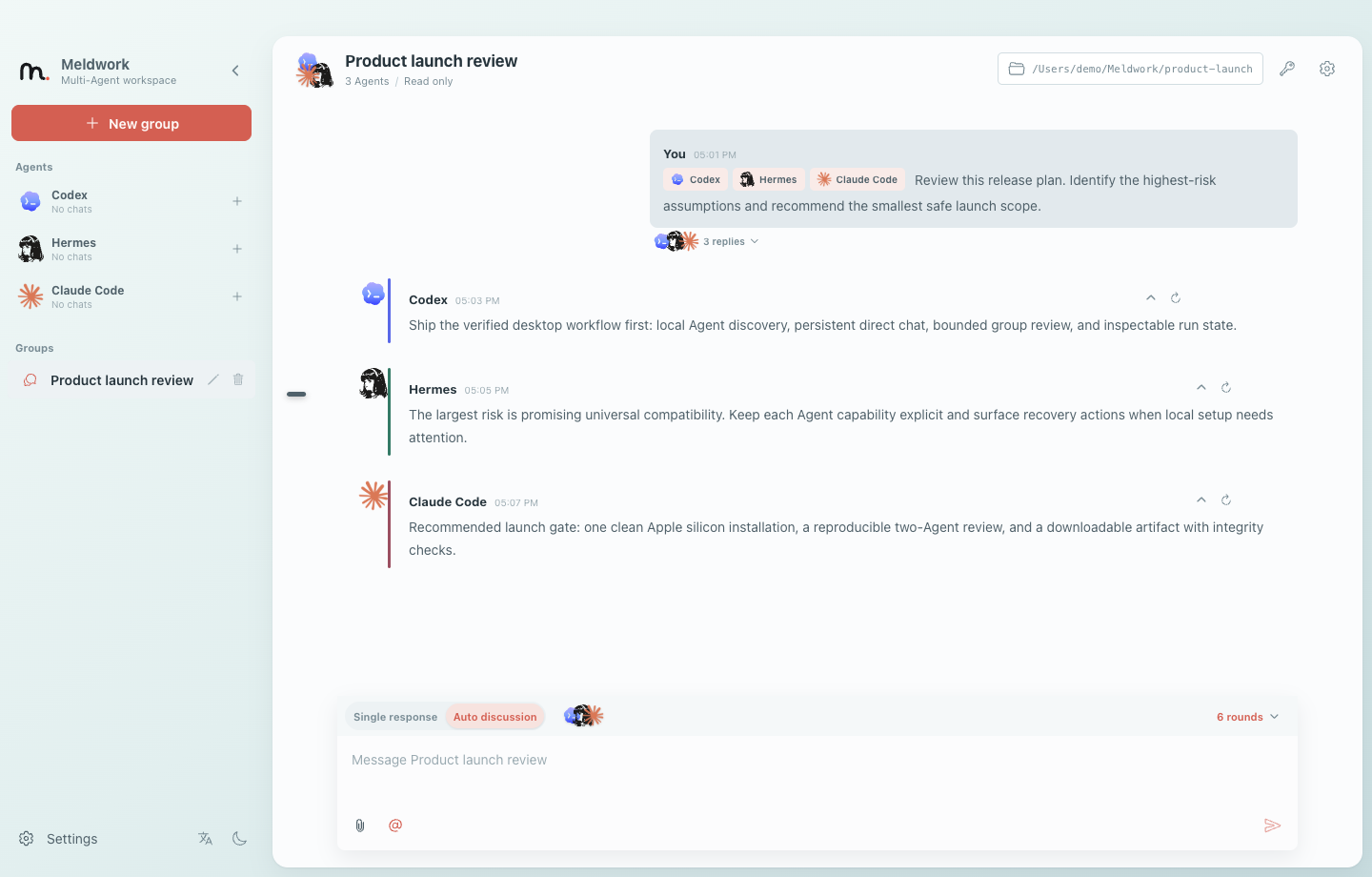
Propose, negotiate, verify — across rounds. Every Agent's position is preserved for later review.
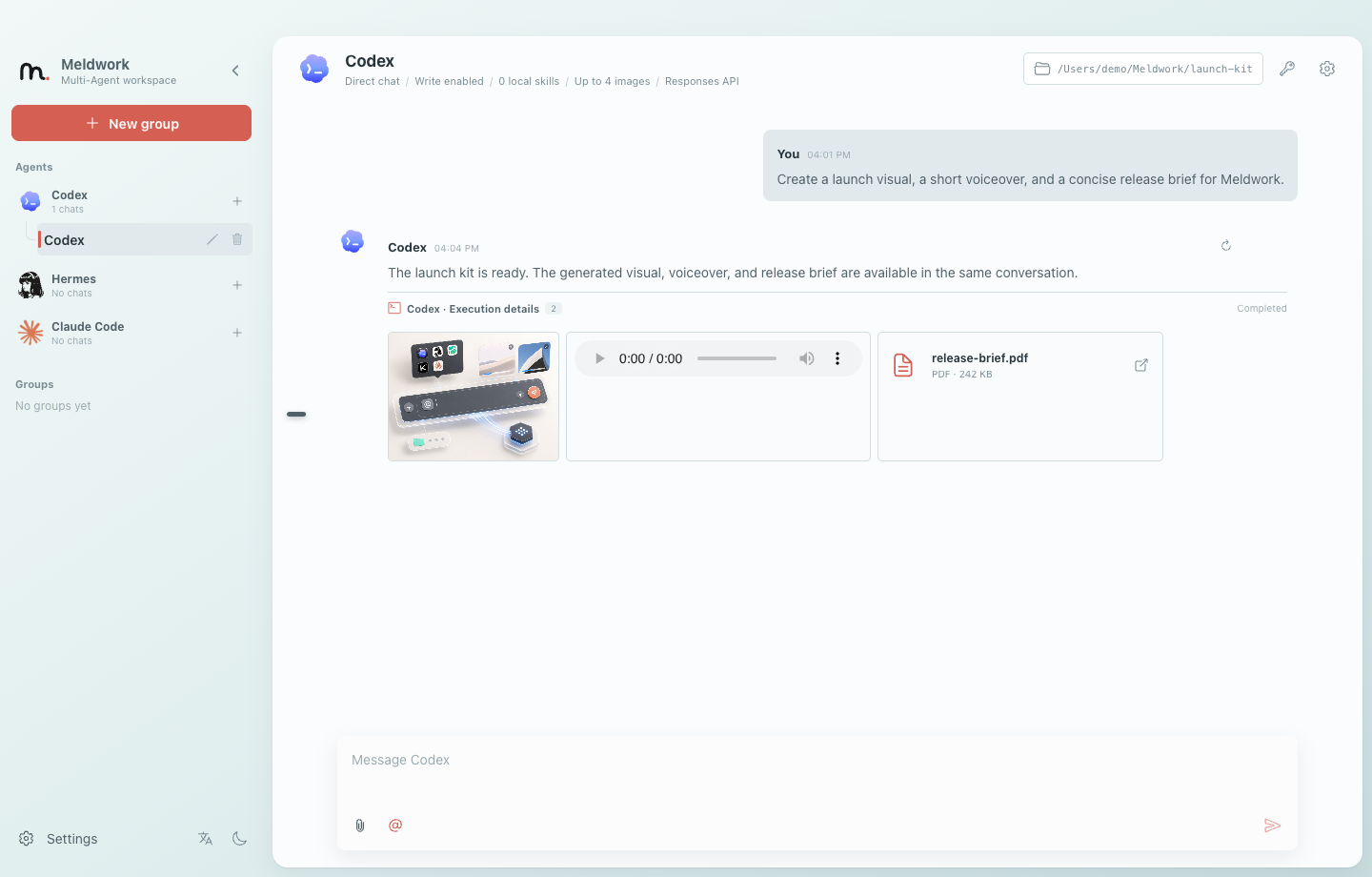
One Agent, its native session preserved. Focused work with the full evidence trail still attached.
Example: give Codex, Claude Code, and Gemini CLI the same change-review context, compare their independent findings, then adopt only the evidence-backed result you approve.
HOW MELDWORK DIFFERS
Meldwork connects the local Agent tools you already use to a decision-ready review workflow — and keeps independent findings, evidence, responsibility, and the human adoption decision visible in one local work cell.
Dissent stays visible. Disagreement, re-checks, and adoption records are tracked — never hidden behind a central manager.
Workspace writes are opt-in workflow controls. You adopt the result — the agents don't.
Runs in your Electron work cell with existing CLIs. No cloud Agent fleet, no required server, conversations stay local.
Case-scoped independent judgments with evidence-backed decisions — not terminal count or worktree throughput.
WHERE MELDWORK FITS
A condensed map of how Meldwork positions itself next to terminal runners, cloud fleets, communication networks, and framework-based orchestrators. Full per-project comparison lives in the README ↗.
THE BOUNDARY
ANSWERS
Short, honest answers — the long versions live in architecture.md ↗.
Meldwork is a local-first work cell for AI coding agents. It orchestrates the agent CLIs you already run — Codex, Claude Code, Gemini CLI, and 9 more — around one frozen task snapshot, records every finding as evidence, and puts a human adoption gate before any workspace change.
No, not by itself. Meldwork runs locally in your Electron work cell. Selected Agents send prompts, attachments, or Skills to their own configured Provider — but Meldwork itself is a local review UI, not a cloud relay. Conversations stay on your machine.
Twelve today — Codex, Claude Code, Gemini CLI, Qwen Code, Kimi Code, MiMo Code, OpenCode, OpenCodeReview, Hermes, Pi Agent, OpenClaw, and WorkBuddy. Approved Agent Connectors can be added through the Agent Connector SDK; custom executables use the desktop custom-Agent path.
Selected Agents independently propose, then critique with evidence, negotiate responsibilities, execute dependency-aware work, and verify the result. Every round is preserved — you can read the full Case later and adopt only the parts you approve.
A terminal runs one Agent at a time and shows raw output. Meldwork scopes a single task across multiple Agents, captures their independent findings, attaches evidence, and keeps the human adoption decision visible as a first-class artifact.
Source-available under the Meldwork Non-Commercial Source License 1.0. You can inspect, run, modify, and share it for non-commercial purposes. Commercial use requires prior written permission — see COMMERCIAL_USE.md ↗.
The current V1.0.3 preview targets Apple silicon macOS (ad-hoc signed, not notarized — open Open Anyway in System Settings → Privacy & Security on first launch). Cross-platform builds are on the roadmap; the app is Electron so the same source compiles everywhere once those targets land.